

Orginally posted Jan 6, 2021 | 7 min read | No spoilers!
What better way to kick off what I hope to be a regular uploading schedule with a film that combines three of my favourite things in cinema? Animation, Imagination and contemplation.
I was recently introduced to this film during a brief conversation with two of my university classmates in which one of the girls I was with asked if I’d watched a certain Japanese film called The Night is Short, Walk On Girl. Shortly after, my Netflix suddenly recommended this exact film to me and so I instantly added it to my watchlist.
And I loved this film. Did I understand everything that happened? Certainly not. But was it at the very least a wild ride? Absolutely.
So instead of just telling you about this indie masterpiece, I’m going to give you 10 reasons why you should watch Masaaki Yuasa’s whacky coming-of-age comedy. The Night is Short, Walk on Girl. I promise you, it’ll be an experience.
1) The experimental animation
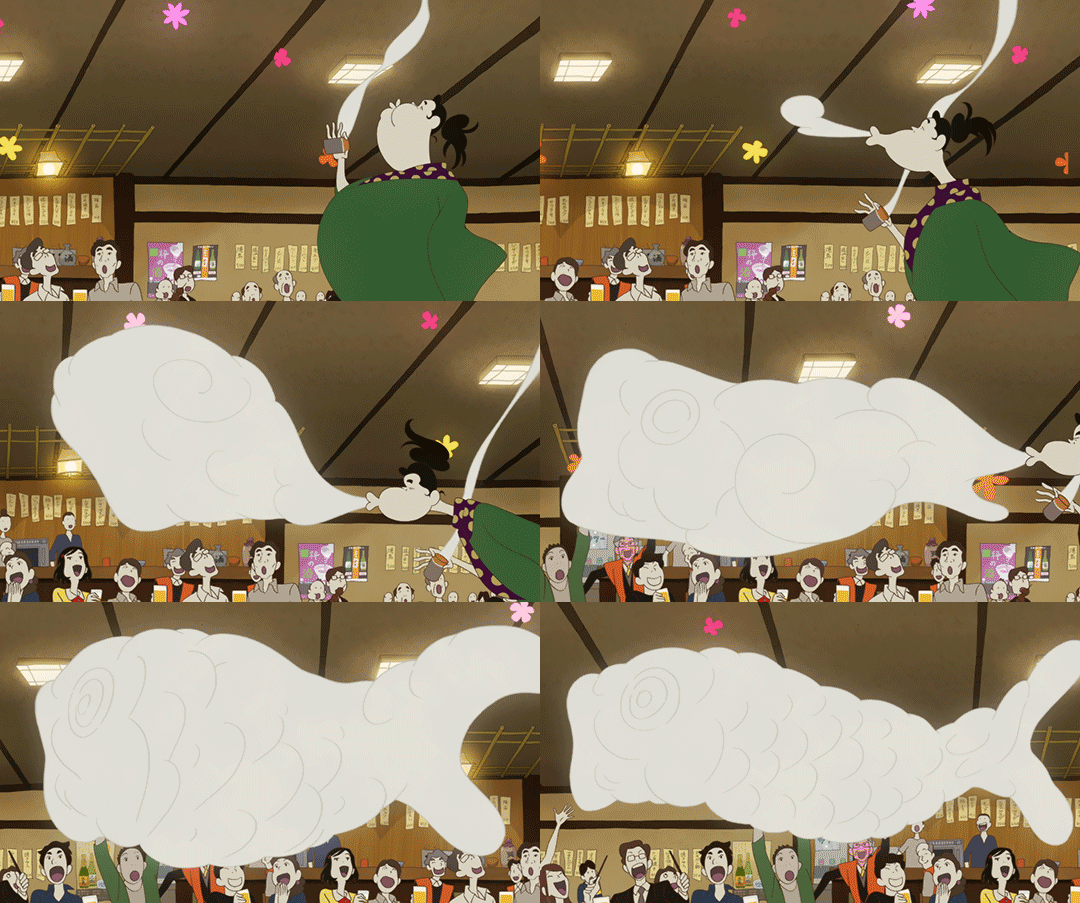
One of my biggest loves and fiercest defences is of animated cinema. This isn’t the first and it certainly won’t be the last article I write praising the versatility, creativity and beauty of animation, and Walk On Girl is a most wonderful example of why.
Animation is a narrative art style free of restraints and realism and can be perfectly utilized to join art and language into an engaging spectacle. It can play with shape, sound, movement and colour to convey themes and create fun, and we see Yuasa’s film play around with this to the max. Sometimes bizarre, sometimes beautiful, it utilizes animation in a way to push and play around with the artform to express a wide range of ideas, shapes and movement.
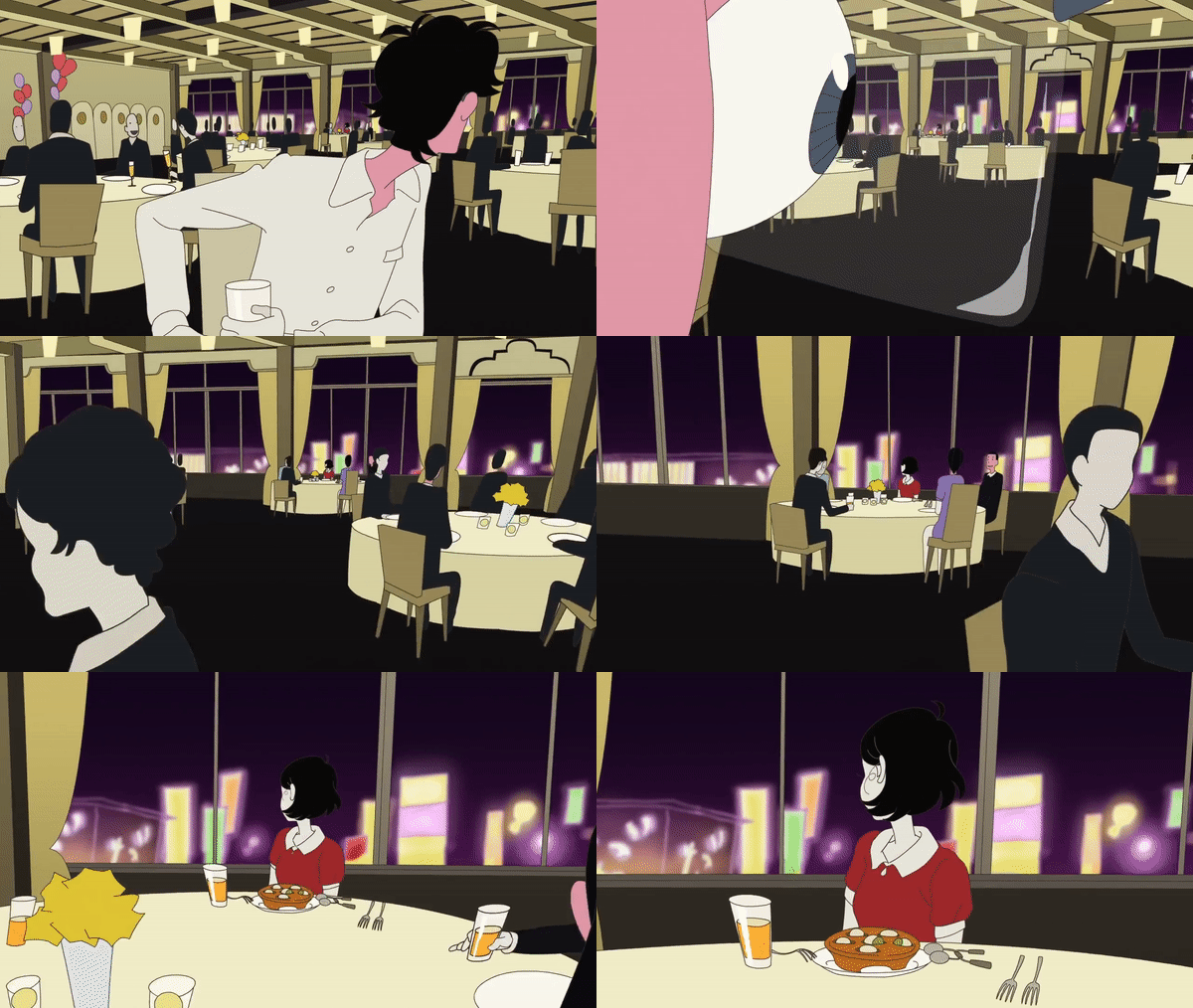
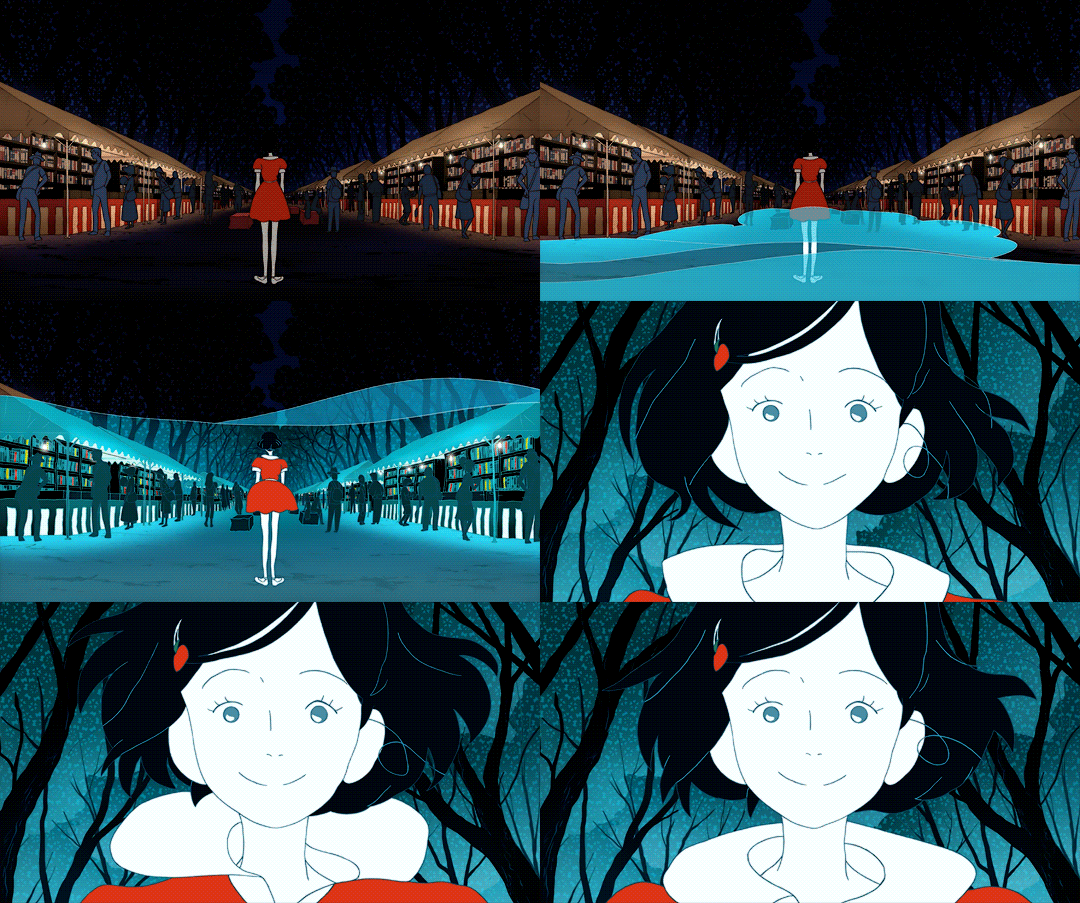

Even if you’re just a casual movie watcher, this is a great film to help push you a out of your comfort zone. It’ll take you on a rollercoaster ride in which you can explore the art of animated cinema as well as Japanese culture and the versatility of film.
Even if you don’t understand what’s going on, at the very least I can promise you’ll find it entertaining.
2) Strange, but story driven
I cannot lie to you, there is a lot going on. Our nameless protagonists’ take us from one scene to the next in a hapless adventure from bars to bookstalls to the inside of people’s homes. There’s weddings, theatre and spicy hot-pot eating contests for children’s literature. It feels like every character you meet has it’s own story to tell, some wackier than others, but luckily the writers still convey a sense of intricated plot. By the second half I felt like I knew all of the individual characters well enough (especially as they’re all so uniquely drawn and characterized) to know exactly what they were after.
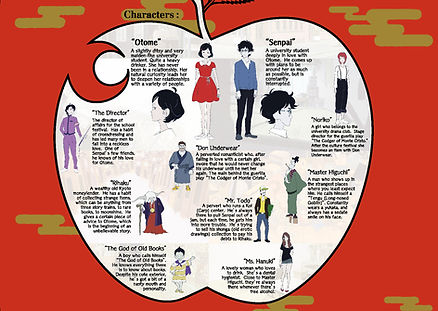
But even if you don’t catch-up quickly, it’s easy to grasp the main thread: Boy in love with Girl, Girl out on the town. The narrative takes you from one bizarre event to the next, and I would argue that the chaotic wackiness of the whole thing is what gives it such an adventurous charm. I never felt like what I was watching was without reason or relevance and, honestly, I think it’s just an experience to be along for the ride.
3) It puts you through so much that you have to root for something

Even if you watch this film and don’t understand a single motive, I feel like it’s impossible not to have a response to something so attention grabbing.
For example, I’m not even sure if I like our male lead. For the first half of the plot I wasn’t sure if we were meant to root for him to actually win the heart of the whimsical Girl with Black Hair. But if you think about it, that’s still an active response: I have to know if she actually ends up liking this guy after all the madness he goes through following her.
There’s just so much going on that it’s impossible to look away. If I walked in to a room where this was playing for only a few seconds, I’d probably see so many different strange things start happening in that short time alone that I’d have to sit down just to make sense of it. What happens at the end of the play? Is that kid really The God of Old Books? Does she ever get a hangover after drinking so much in one night?
4) Use of colour



Alongside the expressive movement of the screen, the still image of this cinematic adventure is just as lovely to behold. Rife with bright, eye-catching tones and compliments against the moody night-time setting, the colours really set the scene of the vibrant Japanese nightlife that this movie is celebrating. Sometimes shifting further into the realm of cartoon with simplified shapes and block colour (shown in the first image here), the production team has really been given free reign to experiment and play around with the composition of colour and shape. The result is an excessively vibrant and expressive atmosphere that adds a sort of childish charm and bubbly excitement to an equally as vibrant and abstract adventure.
5) Taboo themes (?)
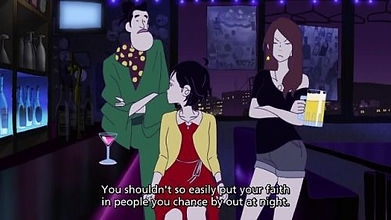
I put a question mark because depending on your preference or experience with film, you may not see this as a compliment to it. I, however, think there’s a great boldness to this particular and it’s casual inclusion of more explicit themes such as alcohol and eroticism. I think there is certainly a place in cinema for inclusivity of uncomfortable subjects and exposure to them (SAFE and legal exposure: just to clarify this is not a children’s film. Official rating is 15.) is necessary for learning. In Night is Short, these explicit themes are closely tied to the rich Japanese culture that permeates throughout this film and gives us a full picture of all parts of the Japanese night culture for the engaged and interested audience. I also like it because it can be used as a prime example that animation is not just for children’s tales. It’s versatility and storytelling creativity can be stretched to all sorts of areas and is perfect for the expression of Walk On Girl’s story, explicit themes and all.
6) A Young Adult Adventure
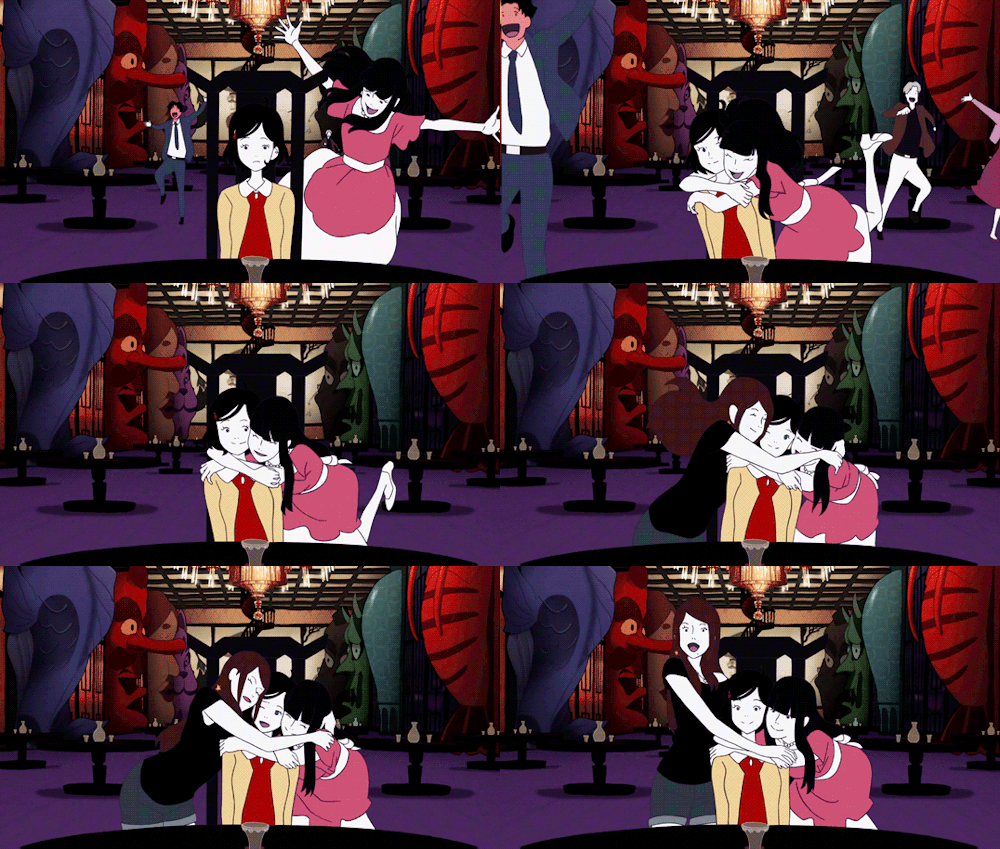
Following on from that, Walk On Girl touches upon many subjects and themes like sex and alcohol, but also freedom, independence, relationships and youth. It is because of it’s explorations of these themes that I feel like it may resonate particularly with the young adults of today who often want to have that moment of stepping out and going where life takes you that the main protagonist expresses (and does!) from the very beginning of the film. It faces these themes with a attitude of curiosity and consideration, not criticism, which I think is a breath of fresh air and a brush of confidence for the curious but withheld YA. The mix of childish fantasy and enthusiasm in its aesthetic with the maturity and questioning of adulthood makes it a delightful journey that can entertain and engage in equal measure. It’s just a fun adventure committed to one ideology: live life, no matter where it takes you. No matter how weird and wacky.
7) That one part about the final scene of the Theatre play.

This part isn’t that insightful, I just think that one scene is an experience. Without spoilers, part of this film involves a notorious travelling theatre show which our “Otome” get’s wrapped up in as a participant. There is one scene which portrays the final scene of the theatre performance and just so much happens in quick succession that you can’t help but laugh at the silliness and extravagance of it all. Even if you thought you weren’t invested, the ridiculous twists and turns that keep on coming without explanation and just capture your attention, whether it’s to laugh, gasp or roll your eyes.
8) Good Discussion piece

As you’ve probably already gotten the impression of, Walk On Girl is chock-full of commentary and thematic explorations that all mix altogether like an abstract reflection of the exciting, busy nightlife depicted throughout the film. The themes aren’t hidden or camouflaged: they’re often very clearly stated and observed by the characters themselves and sometimes don’t have much purpose except to exist. I think the presence of these obvious concepts make for a lot to talk about with peers and friends and could lend themselves towards lots of self-discovery. I feel like the film’s intention is just that. It doesn’t dwell on the subjects because it want’s you to reflect on them and shed your own light. There is enough content there to fuel many a re-watch and to view something differently each time so, if you can, I definitely recommend buddy-watching with someone you can have a good discussion with. My personal recommendation? Any passionate students out there looking to make friends in classes (if you’re braver than me) then I think this could make for a cool film night. And who knows? Maybe they’ll be something for your studies there somewhere.
9) A Wholesome end

After all the craziness of that one night in Kyoto, there’s nothing like a nice relaxing end full of hope and innocence. The final scene is one of calmness and reflection and is like satisfying sigh of relief after a long marathon run (which this film certainly feels like) so you can end on a feeling of journey and experience… even if you’re not quite sure what happened.
10) The School Festival Executive Head is randomly attractive and no I will not explain further

He does the anime hair swoosh.
Just go watch it.
(Update: Just found out the Japanese VA for this guy is also Levi Ackerman in Attack on Titan and Ranpo Edogawa in Bungo Stray Dogs (amongst many others, ofc), so maybe I don’t need to explain further.)
 Eleanor L. Ivy
Leave a comment