
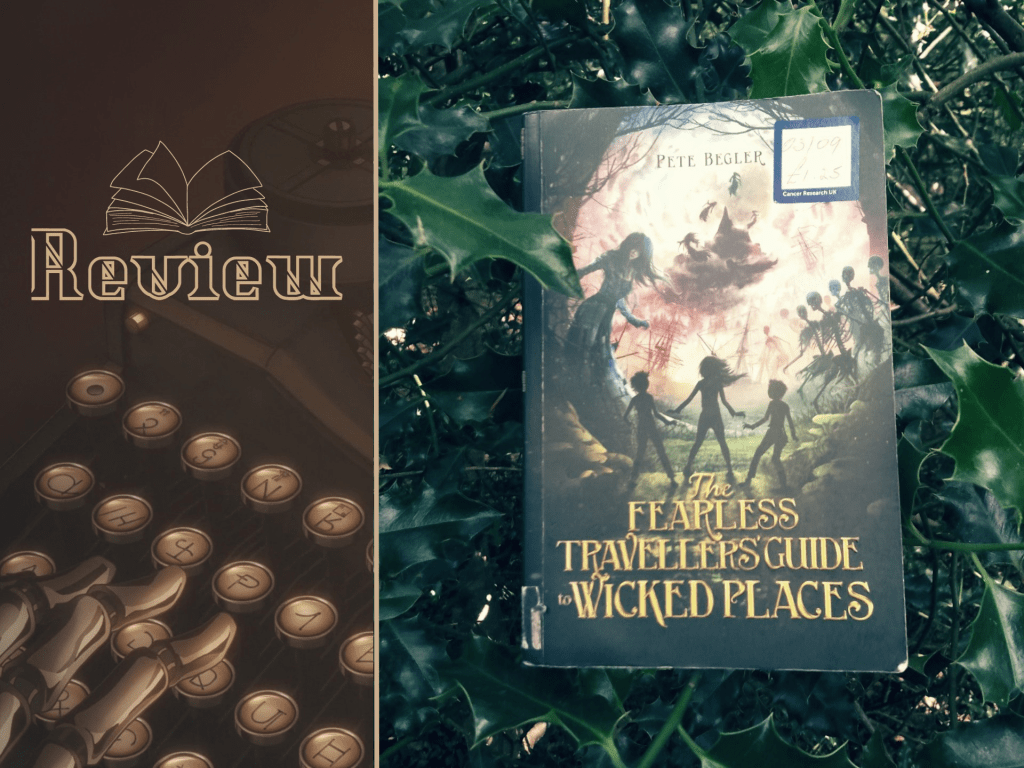
Begler, 2017 | 12 mins | Spoiler free!
Throughout my university years, I’ve been guilty of buying second-hand books for decoration. Particularly in my first two years, I was attracted to many a book sale or charity shop where I could pick up titles I recognised from the Waterstones tables of my secondary school years for fifty pence to a pound. I hardly read any of them at the time, instead putting them on my empty student room shelves in an attempt to make my halls room feel more personal. Now, as I graduate and officially return back home, I find myself partaking in a personal reading challenge of attempting to sweep through all those second-hand books I picked up and didn’t read before finally donating them back. If you saw the size of my bedroom, you would know that I physically cannot afford to keep books I don’t care about.
I didn’t expect to find any hidden gems amongst those titles. Ink (2017, Alice Broadway) was a mid and yet had a little spark of something captivating enough to propel me to buy the second book of the series off Vinted. The Midnight Library (2021, Matt Haigh) was a quick read in which I understood why it became popular with readers, but I ultimately had some unexpected socially-charged gripes with it that I may articulate in a blog post someday. Bedlam (2010, Ally Kennen) was a true random read, reminiscent of school library days when you’d pick up a book you’d never seen (or will see) anyone mention ever because it had a captivating front cover, only for it to linger with you forever in the deepest, blurriest caverns of your memory. If you’re curious to see what other strange and/or surprising titles may come out of this unintentional mini-series of mine, give me a follow me on Goodreads or The StoryGraph; I’ve started titling all my quick-fire reviews of this series with a very subtle Finally Reading The Books I Bought Randomly in Charity Shops Years Ago and Then Never Read: #x.
Now Pete Begler’s The Fearless Traveller’s Guide to Wicked Places (2017) is a true example of cracking open a geode and finding a glittering amethyst inside. It might not be an expensive diamond or a pristine pearl, but it’s still something unexpected to write home about. With only one book to his name and less than 150 reviews on Goodreads (and only 53 on The Storygraph), this book truly reminded me of trips to my school or local library where I’d graze across shelves of Middle Grade books that hadn’t had new arrivals in probably 5+ years and something would catch my eye purely because it was the most fantasy, magic, adventure type-beat a front cover could offer me. This book almost feels like a time capsule in itself, of something that has nothing to do with the story itself but pure semantics. I hope fellow childhood bookworms can understand what I’m getting at here.

I hate to admit it, but I’ve become a hard customer when it comes to the first few chapters of a book. It’s really bad, but my brain has started a habit of being keen to call out even the slightest whiff of a cliché or common trope if I feel it hasn’t been handled with a particular charm or nuance. It’s not a habit I’m proud of – the biggest enemy of creativity is the fear of non-originality, hence why all my story ideas often live in “research” purgatory – but it’s become a natural reflex. The opening mantra did not help set up this book for success with my pretentious brain, but then I remembered I was reading something with a middle grade audience at twenty-two and told my brain to shut up. Thank goodness I did, because this novel quickly becomes a refreshing surprise.
Am I about to tell you that this is the most original middle grade book I’ve ever read? That it’s something special and remarkable and never been seen before? Nope, I’m really not. And yet, there was something so refreshing about this unknown little treasure of a book that I know if I had read it while I was in primary school I would have been besotted.
The Fearless Traveller’s Guide to Wicked Places follows the adventure of three siblings, but most significantly Nell Perkins, as they travel to the Dreamlands in order to save their mother, Rose. The Perkins sibling’s mother has been transformed out of her human form by what one can best describe as a coven of witches, the Dark Daughter’s, whose leader is hatching an evil plan to spread destruction across the world. This villainous plan is missing one key ingredient: Rose’s spirit. Nell and her two younger brothers, Speedy and George, are guided by a grumpy but brave and good-hearted gentleman named Badger and his feline companion, Pinch, who are members of a fantastical order: Fearless Travellers, who traverse the Dreamlands and provide guidance, protection and/or aid to those who journey across the magical lands. Magic umbrellas, mystical entities, flying ships and much more all come together to paint an extravagant adventure story for young readers that delivers a Coraline-like message on fear and courage for young heroes: that true bravery and heroism comes when you are scared and discouraged beyond belief, but persevere anyway. That belief in yourself, your loved ones and sometimes in the unexplained may allow you to become someone you never dared dream you could be.
A land of dreams, nightmares and perilous journey’s undertaken by unwilling but courageous children to save their parent figures are not unheard of concepts, and yet Begler adds a new one to the roster that charms and delights. A staunch adventure story that takes you on a roller-coaster across fantastical lands and with a slew of loveable characters that compliment each other delightfully throughout, the author’s creative ideas manage to come across as bizarrely fitting without tipping too far into gimmicky, which is something I didn’t expect when I realized we were working with dreams here. While sections definitely suffer when it comes to necessary exposition to build up the logic of this world, in retrospective they are easy to overlook. Some of the messaging is very direct and leaves little room for subtlety, sometimes shoe-horning in a quotable teaching delivered from the mouths of one of our protagonists that feel a touch unmoored from the situation, but luckily swiftly moves on. I was pleasantly surprised to find myself whacking out the washi tape, which is my preferred method of annotation that I only take the effort to do if I find I want to remember what it felt to read the book currently in my hands.
Unlike what I imagine Begler intended, my favourite lines often weren’t the inspirational fodder for young minds to latch on to, but instead were where the author’s wit and charisma shone through in humorous little quips and moments. Most of these came from George, Nell’s youngest brother, who was an endless stream of snarky comments that unexpectedly charmed me, especially when it was obvious that under all that childish sass was just an average little boy who loved his family but would rather jump in a river than admit it. This refreshing personality for a child secondary-protagonist merged well with the wiser-than-her-years Nell and soft-hearted Speedy making a very well-rounded trio dynamic. As a comedic relief character that frequently bounced off his more respectful brother and Badger, the easily disgruntled mentor figure, he shone as a more charismatic presence in the story than some of the supposedly “entertaining” side characters that I see attempted today, who exist only to crack hit-or-miss one liners or act as a paragon of stupidity just so an author can justify spelling out the obvious for the reader’s sake. He had a clear dynamic and relevance within the story, unique from his siblings but complimentary and realistic to how I could see your average eight-year-old thrust into an extraordinary situation that stinks of trouble. Speedy, the middle sibling, perhaps gets less attention from the story as the other two, with Nell obviously being the clear-cut heroine who refreshingly balances her uniqueness with a grounded personality that stops her from falling into the dreaded not-like-other-girls/kids-my-age trap. But still he earns his place in the trio as the sweet, soft-hearted boy that frequently embodies the faith and love his family shares which keeps motivating them through all this hardship. They make for an endearing trio of child heroes that I think readers of every age can find engaging and worth following on this fantastic journey.
As for the worldbuilding, I can perhaps see it being a bit too kooky for some people in places. I am honestly surprised I didn’t find myself criticising it more, as I can often be quite reactive to “weird stuff just for weirdness’s sake” and have critiqued such instances in other childlike fantasy stories. However Begler is probably saved by the concept of dreams in which logic is automatically forfeit and his mostly succinct descriptive voice paints a stunning picture but keeps the mission at hand at the forefront of the action which helps this story from drifting too far into unnecessary nonsense. I found myself enthralled by some of the descriptions of the Dreamers; the Maze Dreamer, the Potion Dreamer and even the Dandelion Dreamer being particularly awesome from their unique aesthetics that felt clearly inspired despite their fleeting appearances in the narrative. Beglar is free to be creative as he wants in crafting these imaginative figures and chooses to give each one a clear, distinctive character design that captures something fantastical and yet never too ridiculous, even when the character is more on the stranger side. There is definitely a lot going on in this books landscape, as you could expect from a universe that operates entirely on dreams and nightmares, but I never found myself rolling my eyes at the absurdity. I feel like a certain lack of restrictions in ones imagination can sometimes be a dangerous game, making you feel like you can just throw anything in there without justification because you’ve created a world that allows it, but Beglar somehow manages to paint a world where anything is possible and yet still both believable and unexpected. I can’t quite put my finger on it, but it was a welcome scenario.
Of course this is not a perfect book. Despite my obvious praises of it so far, I’m not trying to convince you that this is a stealth masterpiece that the world has been missing out on. A few, fleeting moments come across as too convenient and I’ve previously mentioned how some sections of writing jar due to either exposition or aspired quotability. These are both things most writers are often guilty of so they often don’t break a book, it’s just that the most skilled of writers are better at hiding it. If Beglar is still out there writing today, (which I would be eager to see!) I imagine he is slowly easing out these creases in his craftmanship. These aren’t things that would stop me from recommending it to anyone. There is also one truly reprehensible character that I hated every second he spent on my page: an annoying leprechaun that unfortunately lingered around our characters more than I needed him to that I felt bordered on Irish stereotyping but I can’t quite articulate how. It was just an instant vibe that prompted a heavy dislike. I do not believe the character is intended to be likable, but he certainly wasn’t loveable from any perspective to me and I wished he didn’t exist to tarnish the charm of this surprisingly lovable book. The clowns being slave traders also catches you wildly out of left field (and other sentences I find myself writing). Especially in a middle grade book that has so far been mostly charming and whimsical. The inclusion of clowns as these genuinely terrifying and horrific nightmare figures that I could definitely see existing in a child’s dreamland was already a very compelling idea. It didn’t need the slave trading business as well to convince us of their villainous nature, it swung just a touch too heavily for me.
So far this seems to be Pete Begler’s first and only novel, although I’m sure there’s still plenty of time for this to change. This book is truly an exemplar of an unknown pearl that perhaps a kid or two has floating silently in the nostalgia sea of their brain. There may not even be many copies of it out there for people to find, but I can picture them clearly in hidden corners of your local library or the shelves of your neighbourhood Cancer Research store. To an author, this probably isn’t a charming notion, to think of your books as existing only in the liminality of second-hand spaces, but for me it rings a particular nostalgic bell in my head that reminds me of childhood. A time before a bookworm was aware of publishing as a business or stories as a marketable game of who’s reading what and which names do I know. A time when you did judge a book by its cover and it took you to unexpected places (sometimes for better or for worse). It speaks to the dusty corners of your brain that holds on to things you didn’t ask it to until a random Thursday evening when something triggers and that ghostly feeling of unexceptional childhood moments simmers slightly in the back of your brain until you shelve it once again. Not to get too poetic or anything.
The Fearless Traveller’s Guide to Wicked Places was published Janurary 1, 2017 by Curious Fox and is available in Hardback, Paperback and on Kindle.
 Eleanor L. Ivy
Leave a comment